We are living through a climate and ecological emergency. The systems that sustain human life – stable climate, fertile soil, clean water – are breaking down, driven by animal agriculture, one of the most destructive industries on Earth.
Changing our food system is key to solving this multifaceted crisis because it allows us to tackle not only one of the biggest emitters of greenhouse gases, but also the leading driver of habitat loss, biodiversity loss and deforestation, the greatest polluter of water, and the largest user of water and land [1]. A 2019 Harvard study showed the UK could be carbon-negative if it combined the switch to a plant-based food system with rewilding the land freed up by this change [2]. Additionally, even if fossil fuel emissions were all eliminated immediately, the emissions from the agricultural sector alone would make it impossible to limit warming to 1.5°C, and difficult even to keep it below 2°C [3]. Beyond its current destructiveness and unsustainability, a food system that isn’t largely plant-based will simply not be possible in the future, with food demand and meat demand expected to increase by 50% and 70% respectively by 2050, requiring an additional 33 million km2 of land, eliminating all of the world’s forests and savanna [4].
Scotland used to have a beautiful rainforest running the full length of its west coast, but only a fraction of it still stands, as nearly all of it was deforested to create space for pastures and crops to feed animals. Nearly all of the British landmass used to be forested. With a plant-based food system, we would be able to bring back up to 75% of it [5], thereby also allowing biodiversity to return to levels unseen in our lifetimes.
The burden of the environmental crisis is also far from equal. Communities in the Global South are already facing droughts, floods, and biodiversity collapse, while their land and waters are exploited to feed animals for consumption in wealthy countries, often contributing to local food insecurity [6]. Despite their minimal historical contribution to emissions, poorer countries are bearing the brunt of the crisis. In the UK, it disproportionately affects marginalised and disadvantaged communities [7]. At the same time, younger generations everywhere are being locked into an uncertain future.
Additionally, a plant-based food system is far easier to implement quickly than a complete shift away from fossil fuels: we simply need to change the food offered.
And the benefits don’t stop here. Plant-based catering also means everyone has more options, not only because everyone can have plant-based food—which is not the case of animal products, that many people cannot eat for religious, personal or health reasons—but because it is naturally lactose-free (and 65% of the world population, particularly from the Global South, is lactose intolerant), naturally Halal (with all our Muslim students today being limited to the vegetarian and plant-based options due to the lack of Halal catering), and very easily Kosher. It would also be an opportunity to make the food on campus healthier and have a large consultation with staff and students to make it more accessible to people with allergies, sensory sensitivities, and other food requirements. And on top of all this, research has found that plant-based catering can be up to 30% cheaper [8], so the food would be even more accessible to everyone.
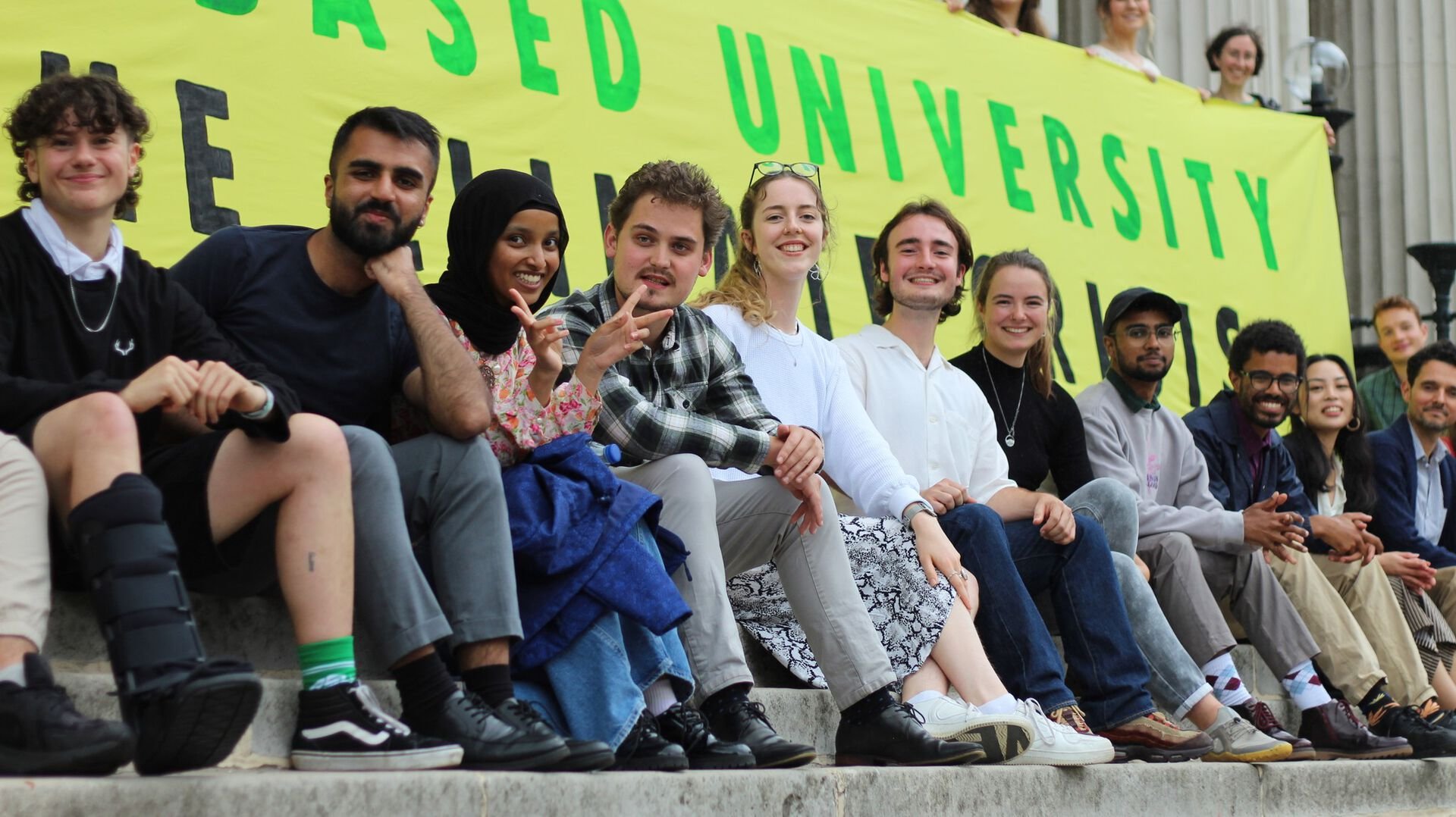
These are just some of the reasons why plant-based catering is now urgently needed, and universities across Europe are finally waking up to the advantages of such an effective solution. Students at 24 universities have already voted in favour of fully plant-based catering, with many, such as Stirling, opening fully plant-based outlets. Student unions at leading institutions including Cambridge, UCL, Imperial and many across Europe have backed the initiative, prompting headline coverage and real menu shifts [9]. Graz opened a 100% plant-based canteen in 2024, Vienna transitioned multiple canteens to 70% plant-based and 100% meat-free menus, and Erasmus University Rotterdam has pledged a fully vegan campus by 2030. Meanwhile, universities in Hamburg, Mainz, and Bochum now run entirely plant-based or vegetarian canteens, proving the model’s economic and social success.
So the question is not whether we need to transition to plant-based food, but how. Demanding 100% plant-based institutions is a proportional response to the urgency and scale of the crisis, a way to match science with action and begin building the future we need.
If food systems need to change, universities are one of the best places to start, as highlighted by the Lancet Journal itself [10]. Universities like Edinburgh Napier have produced so much of the science demonstrating the need to move away from meat and dairy, yet they still profit from and serve them every day. That contradiction makes them part of the problem. To stay credible, universities have to live up to their own research.
But it is about more than research. Universities have the power, and with it the responsibility, to make sustainable choices easy, affordable, and inclusive — helping individuals take part in the solutions to the climate and nature crises. For too long, the burden of change has been placed solely on individuals, while the systems shaping our choices have stayed the same. On most campuses, eating sustainably is still harder than it should be: options are limited, often unaffordable, and treated as secondary rather than central to climate action. By recognising the importance of plant-based food and making it the default, universities can empower their communities to live their values and lead the transition our future depends on. What happens on campuses shapes society: the debates in lecture halls, the culture in student unions, the values graduates take into the world. When universities act on climate, it shifts what people see as normal, possible, and necessary. And history is clear: universities don’t make these changes on their own. It takes students and staff power to convince institutions to practise what they teach, and to spark the wider cultural shift we need to create an inclusive, fair and sustainable food system.
We are calling on the University of Edinburgh Napier to adopt 100% plant-based catering as a key solution to both the climate and biodiversity crises. We aim to do this in a way that supports all university students, staff, and caterers throughout the transition. We are asking for an institutional change, not individual dietary changes. It is important that students and staff can still bring whatever food they like onto campus.
Help us bring about the transformative change our universities need to finally end the climate and biodiversity crisis!
[1] Crippa et al. 2021; Machovina et al. 2015; Benton et al. 2021; UN - Facts about the water crisis; The Royal Society - How do humans affect biodiversity?; Ritchie - Drivers of deforestation; UN - World Water Development Report 2024; FAO (SOLAW) 2011; Ritchie & Roser 2024 [2] Hayek & Harwatt 2019 [3] Clark et al. 2020 [4] WRI. 2018. Creating a Sustainable Food Future. [5] Ritchie 2021 “If the world adopted a plant-based diet, [...]” [6] SEI. Trase: Brazilian soy exports and deforestation. 2025; Tacon & Metian 2009; Belton & Thilsted 2014; FAO. Socio-economic and biological impacts of the fish-based feed industry for sub-Saharan Africa. 2022. [7] Richardson et al. 2010; The Health Foundation. Inequalities in likelihood of living in polluted neighbourhoods. 2024; [8] Bryant Research. Climate-Conscious & Cost-Effective: A Case for Plant-Based University Catering. 2024; [9] wikipedia.org/wiki/Plant-Based_Universities; [10] Krattenmacher et al. 2023;